


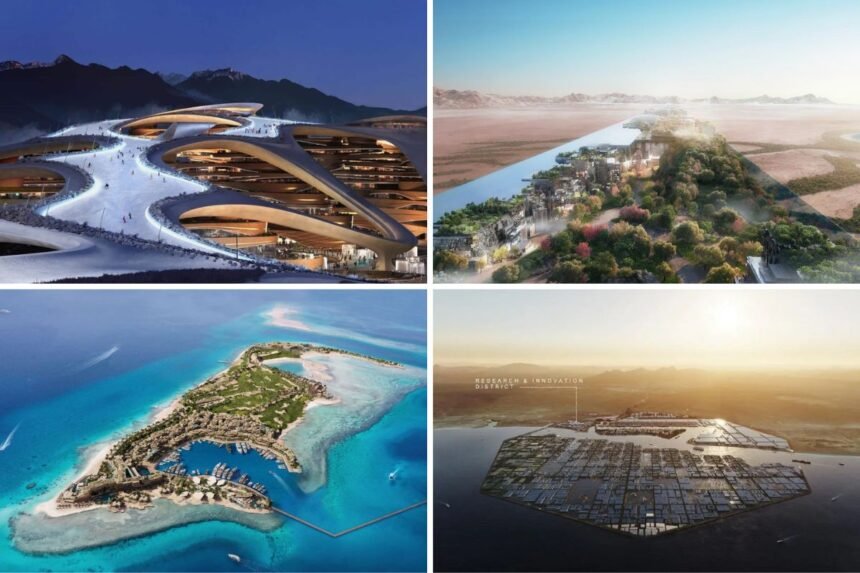
NEOM New Projects Latest Developments Mega Projects & Update
Few projects in modern history have captured global attention quite like NEOM new projects. Rising from the deserts of northwestern Saudi Arabia along the Red Sea coast, this futuristic mega-development is more than an ambitious construction project, it represents one of the world’s largest economic transformation experiments.
- 1. NEOM New Projects: The Line Could Create an Entirely New Urban Economic Model
- 2. Oxagon Could Turn Saudi Arabia into a Global Manufacturing Hub
- 3. Green Hydrogen Production Could Redefine Global Energy Markets
- 4. Luxury Tourism Destinations Could Challenge Established Gulf Hotspots
- 5. Trojena Could Create the Middle East’s Most Unusual Tourism Economy
- 6. NEOM Could Trigger a New Gulf Talent Competition
- 7. Massive Infrastructure Spending Could Benefit the Entire GCC
- 8. NEOM Could Accelerate Saudi Arabia’s Rise as a Global Investment Destination
- Conclusion
Backed by Saudi Arabia’s Vision 2030 strategy, NEOM New Projects is designed to reduce dependence on oil revenues and position the Kingdom as a global hub for technology, tourism, renewable energy, logistics, and advanced manufacturing.
With investments estimated in the hundreds of billions of dollars, the project’s impact could extend far beyond Saudi Arabia, reshaping trade routes, investment flows, labor markets, and tourism across the Gulf Cooperation Council (GCC) region.
As 2030 approaches, economists, investors, entrepreneurs, and travelers are asking a crucial question: how exactly could NEOM new projects transform the Gulf economy? Here are eight major developments that could redefine the region’s future.
1. NEOM New Projects: The Line Could Create an Entirely New Urban Economic Model
Perhaps the most famous part of NEOM New Projects is The Line, a proposed 170-kilometer linear city designed without traditional roads or cars. Located near the Gulf of Aqaba, The Line aims to accommodate millions of residents within a compact, vertically layered urban environment.
Unlike conventional Gulf cities such as Riyadh, Dubai, or Doha, The Line proposes a radically different approach to urban planning:
- Zero-emission transportation
- AI-powered infrastructure
- Walkable neighborhoods
- High-speed transit systems
- Integrated residential and commercial districts
If successful, The Line could become a global model for future cities and establish Saudi Arabia as a leader in urban innovation. The project may also stimulate demand for construction materials, engineering services, smart city technologies, and artificial intelligence solutions throughout the Gulf region.
2. Oxagon Could Turn Saudi Arabia into a Global Manufacturing Hub
Located on the Red Sea coast, Oxagon is being developed as one of the world’s largest floating industrial and logistics hubs.
Its strategic position places it near major international shipping routes connecting Europe, Asia, and Africa. By 2030, Oxagon aims to attract industries such as:
- Advanced manufacturing
- Robotics
- Renewable energy
- Hydrogen production
- Maritime services
- Supply chain logistics
For Gulf economies traditionally dependent on hydrocarbons, Oxagon represents a shift toward industrial diversification. Companies operating in ports such as Dubai’s Jebel Ali, Abu Dhabi’s Khalifa Port, and Qatar’s Hamad Port may increasingly collaborate with or compete against Saudi Arabia’s emerging logistics ecosystem.
The resulting competition could accelerate innovation across the GCC.
3. Green Hydrogen Production Could Redefine Global Energy Markets
One of NEOM’s most significant economic bets is renewable energy and green hydrogen production.
Saudi Arabia’s northwestern region benefits from exceptional solar and wind resources. Massive renewable energy facilities planned within NEOM New Projects could help establish the Kingdom as one of the world’s largest exporters of green hydrogen.
This development has major implications:
- Reduced global reliance on fossil fuels
- New export opportunities for Gulf countries
- Increased investment in clean technologies
- Expansion of energy infrastructure projects
- Growth in international climate partnerships
As Europe and Asia accelerate their transition toward cleaner energy sources, Gulf economies that adapt quickly could maintain their role as global energy leaders even in a post-oil era.
4. Luxury Tourism Destinations Could Challenge Established Gulf Hotspots
For decades, cities such as Dubai and Abu Dhabi have dominated Gulf tourism. NEOM aims to introduce a new category of ultra-luxury, sustainability-focused travel experiences.
Projects like Sindalah Island, NEOM New Projects luxury island destination in the Red Sea, are designed to attract affluent travelers, yacht owners, and international investors.
Future attractions are expected to include:
- Luxury beachfront resorts
- Exclusive marinas
- Wellness retreats
- Adventure tourism experiences
- Mountain resorts in the Trojena region
- International sporting events
The nearby Red Sea coastline, coral reefs, and mountain landscapes offer a tourism experience dramatically different from traditional urban Gulf destinations.
Hotels, airlines, restaurants, and hospitality operators throughout Saudi Arabia and neighboring countries could benefit from increased regional tourism demand.
5. Trojena Could Create the Middle East’s Most Unusual Tourism Economy
One of NEOM new projects most surprising developments is Trojena, a mountain tourism destination planned within Saudi Arabia’s Sarawat mountain range.
Trojena aims to offer:
- Outdoor adventure tourism
- Ski facilities
- Luxury mountain resorts
- International events
- Wellness and eco-tourism experiences
This project challenges long-standing assumptions about tourism in the Middle East. Rather than relying solely on beaches and luxury shopping, Saudi Arabia is positioning itself as a year-round adventure destination.
If successful, Trojena could encourage similar investments throughout the Gulf and attract travelers who previously overlooked the region for outdoor tourism experiences.
6. NEOM Could Trigger a New Gulf Talent Competition
Economic transformation requires human capital.
NEOM’s ambitions in technology, biotechnology, artificial intelligence, robotics, renewable energy, and advanced manufacturing are already creating demand for highly skilled professionals.
By 2030, Gulf countries may increasingly compete to attract:
- Engineers
- Scientists
- Software developers
- Entrepreneurs
- Architects
- Sustainability experts
- Researchers
This competition could lead to:
- Improved education systems
- Expanded research institutions
- Higher wages for skilled professionals
- Increased international migration
- Stronger startup ecosystems
Cities across the Gulf may accelerate investments in innovation districts and technology parks to remain competitive.
7. Massive Infrastructure Spending Could Benefit the Entire GCC
NEOM New Projects construction requirements are staggering.
The development requires investments in:
- Airports
- Ports
- High-speed rail systems
- Renewable energy plants
- Water desalination
- Telecommunications networks
- Residential communities
- Healthcare facilities
As a result, companies across Saudi Arabia, the UAE, Qatar, Bahrain, Kuwait, and Oman could benefit from contracts, partnerships, and supply agreements.
Construction firms, engineering consultancies, logistics providers, and financial institutions throughout the Gulf are likely to play important roles in delivering various components of the project.
This regional economic spillover effect may become one of NEOM’s most significant long-term contributions.
8. NEOM Could Accelerate Saudi Arabia’s Rise as a Global Investment Destination
Perhaps the most important impact of NEOM is psychological rather than physical.
For decades, international investors viewed Gulf economies primarily through the lens of oil and gas. NEOM is helping reposition Saudi Arabia as a destination for:
- Technology investment
- Venture capital
- Artificial intelligence
- Tourism development
- Renewable energy
- Biotechnology
- Advanced manufacturing
Major global companies and investment funds are increasingly monitoring opportunities connected to Saudi Arabia’s economic transformation agenda.
If NEOM New Projects achieves even part of its objectives by 2030, it could permanently alter international perceptions of the Gulf economy and encourage further diversification across the region.
Conclusion
NEOM remains one of the world’s most ambitious economic development projects. While challenges related to scale, timelines, and execution remain, its potential impact on the Gulf economy is undeniable. By reshaping industries ranging from tourism and logistics to renewable energy and technology, NEOM New Projects could help define what the Middle East’s economic future looks like well beyond 2030.
Do follow us on Instagram.
Read More – Best Places to Buy Property in Riyadh in 2026 for Maximum Returns